
Arizona Ranks #2 in "Why Rural Matters 2025" Report, Highlighting Urgent Needs for Rural Education
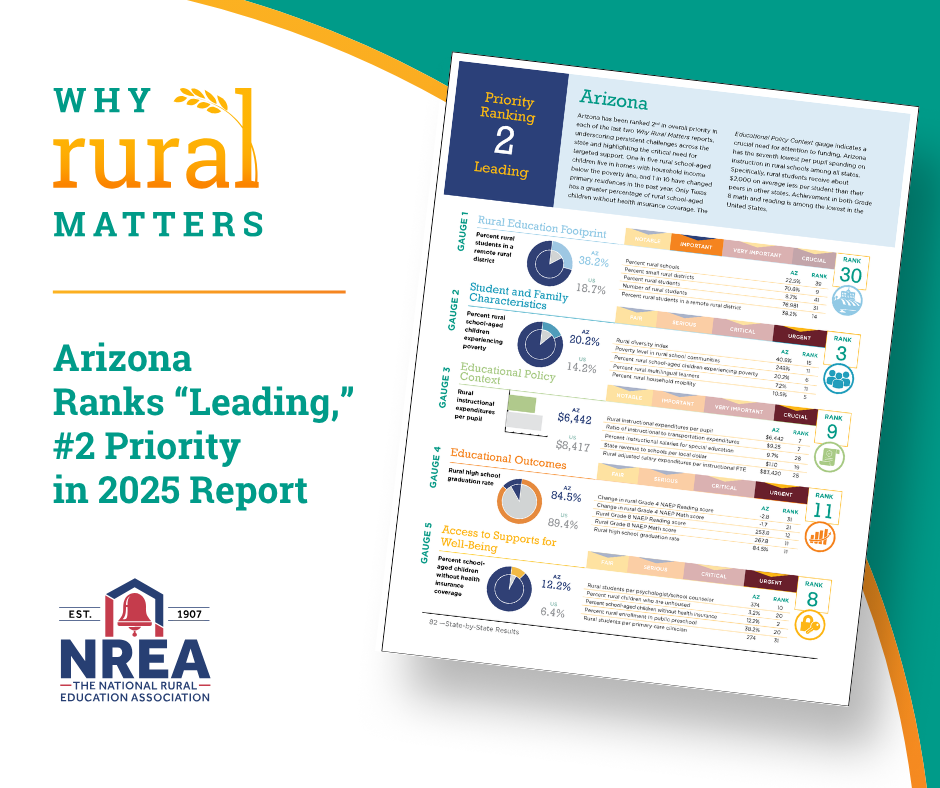
San Tan Valley, AZ - The National Rural Schools Association (NREA) recently released its Why Rural Matters 2025 report, a comprehensive analysis that examines the state of rural K-12 education across the United States. Originally developed by the Rural Schools and Community Trust, the report has provided valuable insights into rural education for over two decades, serving as a critical resource for policymakers, educators, and communities.
As the 11th edition in a series of biennial reports, Why Rural Matters 2025 offers an in-depth look at key trends and conditions impacting rural education, shedding light on issues that affect nearly 10 million students across the nation. This report is especially important as federal and state education policies undergo significant changes.
“Twenty-two percent (22%) of Arizona’s schools are rural, educating nearly one in ten students in the state,” said Dr. Greg Wyman, Executive Director of the Arizona Rural Schools Association (ARSA). “Of these, 70.6% are considered small rural schools. The approximately 160 rural school districts across Arizona are diverse, both racially and linguistically, making the findings of this report particularly relevant for informing policy decisions.”
The Why Rural Matters 2025 report ranks states based on five key factors, referred to as "gauges", that reflect the state of rural education. These gauges are measured using various indicators that highlight a state's unique needs, providing a priority ranking for each state. The priority ranking reflects a state’s need for support, with #1 indicating the highest need and therefore the highest importance for policymakers to address rural educational issues.
Arizona ranks 2nd in overall priority for the second consecutive report, signaling persistent challenges and a critical need for targeted support. Notably, this marks Arizona’s fourth appearance, out of five reports, in the top ten. The one exception, the 2018-19 report, where Arizona was ranked 11th.
Among the findings specific to Arizona:
38.2% of students in Arizona’s rural districts attend schools located in remote rural areas, compared to 18.7% nationally.
20.2% of Arizona’s rural school-aged children live in poverty, significantly higher than the 14.2% national rate.
12.2% of Arizona’s rural school-aged children are uninsured, more than double the 6.4% national average.
Arizona's rural schools face a 347:1 ratio for students per school psychologist or school counselor, far higher than the national rural average of 297:1 and the non-rural national ratio of 273:1.
Financially, Arizona’s rural schools face funding challenges as well. The report reveals that Arizona ranks 7th in rural instructional expenditures, investing $6,442 per pupil, compared to the national average of $8,417. However, rural school leaders recognize the importance of teachers. Arizona rural school teacher salaries have a priority ranking of 25th in the nation, averaging $83,420 per full-time instructional employee (FTE), slightly above the national average of $83,256.
As the Arizona Legislative session begins, ARSA urges the state’s lawmakers to prioritize addressing the unique challenges faced by rural schools. Specifically, ARSA calls on the Arizona Legislature to ensure equity in funding for all public schools, with particular emphasis on rural districts.
“We urge Arizona legislators to consider the unique needs of rural schools and to adjust the state’s funding formula to reflect these disparities,” Dr. Wyman added. “This could include establishing a rural school weight within the funding formula, similar to weights for special education, English Language Learners, or gifted students. It’s critical that every student in Arizona has access to a quality education, no matter where they live.”
ARSA also calls on the Legislature to ensure equity through accountability for all K-12 educational institutions that accept public taxpayer dollars. Accountability and transparency are critical for any educational institution accepting public tax dollars.
The Arizona Rural Schools Association and its member school districts remain committed to advocating for the needs of Arizona’s rural students, educators, and communities. This commitment includes a pledge to continue to work with policymakers to address the disparities highlighted in the Why Rural Matters 2025 report.
--
The Arizona Rural Schools Association (ARSA) was founded in the early 1980s and was established to address the unique issues facing rural schools in Arizona. Currently representing approximately 70% of the school districts in Arizona, which educate 20% of the students K-12 in the state. Dr. Greg Wyman, Executive Director, can be reached at execdir@azruralschools.org.